Regrow your own hair, with your own biology.
A non-surgical protocol combining platelet-rich plasma with MCT exosomes to reactivate dormant follicles, extend the growth phase, and thicken the hair you still have. No incisions, no general anesthesia, no downtime.
Thinning hair is a signalling problem before it is a follicle problem.
In pattern hair loss, follicles are rarely gone. They miniaturise — each cycle produces a finer, shorter, less pigmented hair, until the shaft is barely visible. What drives that shift is the environment around the follicle: reduced microvascular supply, chronic low-grade perifollicular inflammation, and a shortage of the growth signals that keep the anagen (growing) phase long.
Regenerative injectables target that environment directly. PRP supplies your own concentrated growth factors. MCT exosomes supply a purified, standardised signalling payload. Used together, they aim to lengthen anagen, improve blood supply, and pull miniaturised follicles back toward producing thicker, pigmented hair.
Platelet-rich plasma: your own growth factors, concentrated.
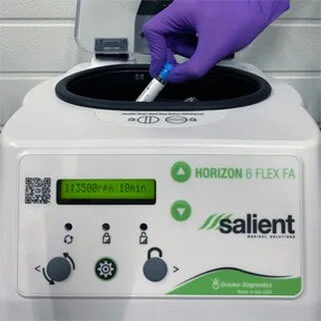
We draw a small volume of your blood, spin it in a centrifuge, and separate the platelet-rich fraction from red cells and platelet-poor plasma. Platelets are storage vesicles for repair signals — PDGF, VEGF, IGF-1, TGF-β, EGF. Concentrated and injected into the scalp at the level of the follicle, they do three things.
Wake dormant follicles
Growth-factor signalling pushes follicles out of the resting (telogen) phase and back into active growth.
Rebuild the blood supply
VEGF-driven angiogenesis widens the microvascular network feeding each follicle — more oxygen and nutrients per cycle.
Thicken the shaft
A longer growth phase means a longer, coarser, better-pigmented hair — the reverse of miniaturisation.
What MCT exosomes are — and why we add them.
Exosomes are nanoscale vesicles — roughly 30 to 150 nanometres — that cells release to communicate with one another. They are not cells and they do not replicate. Each one is a lipid-membrane package carrying a cargo of growth factors, cytokines, messenger RNA and microRNA, addressed to nearby tissue. In effect, they are the instruction set a regenerative cell would have sent, delivered without the cell.
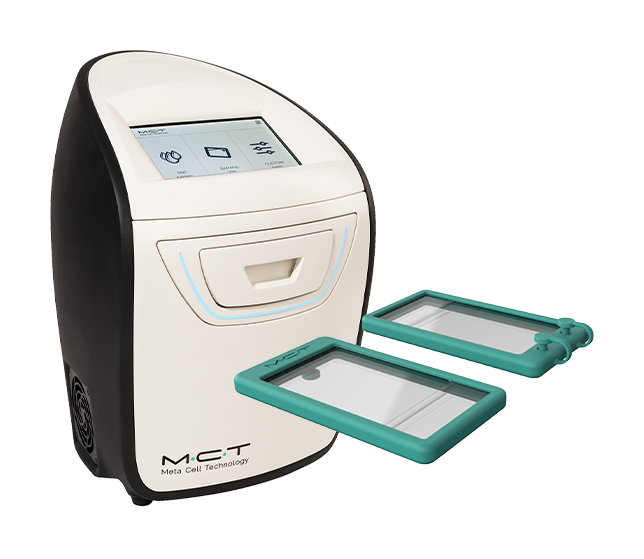
The MCT exosome product we use is a purified, lab-characterised exosome isolate produced under controlled conditions from mesenchymal-lineage cell culture, then filtered, concentrated and batch-tested for particle count, sterility and endotoxin. That controlled sourcing is the point: unlike PRP — whose potency rises and falls with your platelet count, age, sleep and medication — an MCT exosome vial delivers a consistent, standardised signalling dose every session.
Extends the growth phase
Wnt/β-catenin and related pathways are the switches that hold a follicle in anagen. Exosomal microRNA is thought to nudge those switches on.
Calms the follicle
Anti-inflammatory cytokines reduce the perifollicular inflammation that accelerates miniaturisation in androgenetic and post-inflammatory loss.
Feeds the dermal papilla
The dermal papilla is the follicle’s control centre. Exosomes support papilla-cell proliferation and new capillary formation around it.
Amplifies the PRP
PRP delivers volume of growth factors; exosomes deliver specificity. Layered in the same session, each addresses what the other lacks.
Exosome therapy for hair loss is an emerging, actively researched application. Exosome products are not FDA-approved for the treatment of hair loss, and results vary between individuals. We will tell you plainly, at consult, what the current evidence does and does not support for your specific pattern of loss.
PRP alone, or PRP with exosomes?
| PRP ALONE | PRP + MCT EXOSOMES | |
| Source of signal | Your own platelets | Your platelets + standardised exosome isolate |
| Dose consistency | Varies with your blood on the day | Batch-tested particle count, session to session |
| Best suited to | Early thinning, good baseline density | Stalled PRP response, diffuse or post-transplant thinning |
| Blood draw required | Yes | Yes — exosomes are layered into the same session |
| Typical first visible change | Reduced shedding by week 4–6 | Reduced shedding by week 3–5, often faster density gain |
| Per session | $300 | $550 |
One visit, six steps, about forty-five minutes.
Everything happens in-office. You arrive, you are treated, you drive yourself home. Most patients return to work the same afternoon.
ASsessment
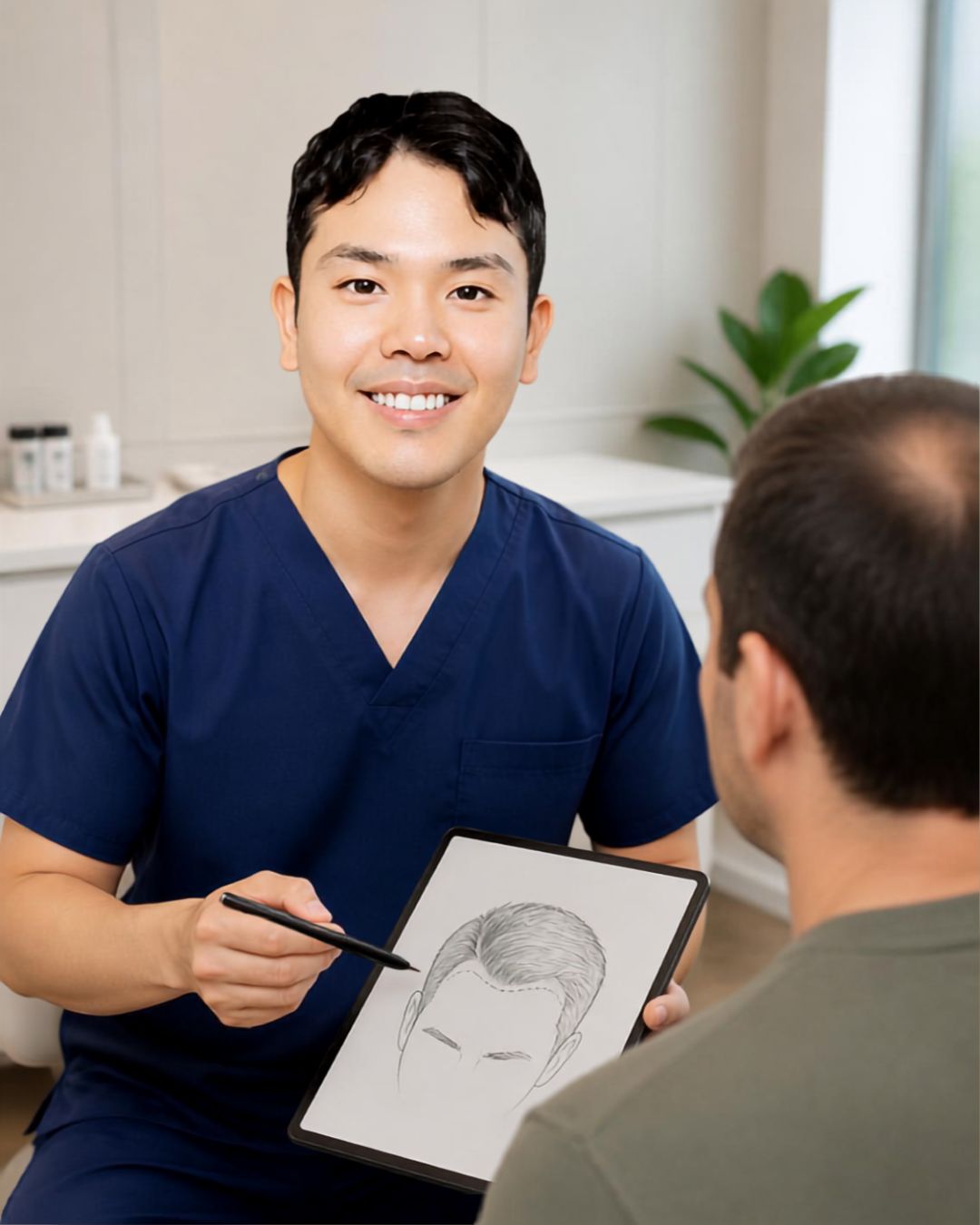
We review history, medications, thyroid and iron status, and any family pattern. Trichoscopy and standardised baseline photography document density and shaft calibre by zone, so progress is measured rather than remembered.
Blood draw
A small volume — comparable to a routine lab draw — is taken from the arm into a closed, sterile collection system. Nothing else is added to your blood.
Centrifugation
The sample is spun to separate plasma, platelets and red cells. We draw off the platelet-rich layer and discard the rest. While the centrifuge runs, your scalp is cleansed and topical anaesthetic is applied.
Exosome preparation
The MCT exosome vial is brought to temperature and reconstituted at the chair, immediately before injection. Lot number and batch data are recorded in your chart for traceability.
Micro-injection
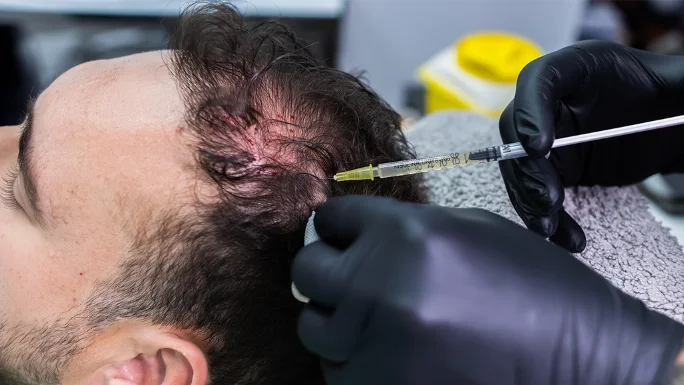
A grid of shallow injections places the preparation at follicular depth — roughly every centimetre across the thinning zones, hairline and crown included. Patients describe brief pressure rather than pain. No sedation, no scalpel.
Home the same hour
You leave with written aftercare and your next session booked four weeks out. Repeat photography at each visit is compared against your baseline at session three.
What to expect, and when.
Hair grows on hair’s schedule. A follicle re-entering anagen needs months, not weeks, to show a visible shaft — which is why we photograph rather than guess.
Week 1
Mild scalp tenderness and pinpoint redness for 24–48 hours. Nothing visible to anyone else.
Week 4–6
Shedding typically slows — usually the first sign the protocol is working. Fewer hairs in the shower drain.
Month 3
Fine new growth appears at the hairline and part. Trichoscopy usually shows it before the mirror does.
Month 4–6
The window most patients call the turning point: increased density and thicker calibre in treated zones.
Month 9–12
Peak result, then maintenance: one booster every 4 to 12 months depending on how you respond.
Am I a candidate?
- —Early to moderate pattern thinning with follicles still present
- —Diffuse or postpartum thinning in women
- —Plateaued on minoxidil or finasteride and looking for more
- —Post-transplant patients wanting density between grafts
- —Anyone who wants a non-surgical option before considering surgery
- —Fully scarred or long-bald scalp with no viable follicles
- —Active scalp infection, or an undiagnosed cause of shedding
- —Blood or platelet disorders, or anticoagulant therapy
- —Pregnancy or breastfeeding
- —Active malignancy or immunosuppressive therapy
Recovery is a day of small rules.
First 6 hours
Nothing on the scalp. No hats, no product, no touching the injection sites.
First 24 hours
No shampoo, no swimming, no sauna. Sleep on a clean pillowcase.
First 48 hours
Skip heavy training and alcohol. Avoid NSAIDs — they blunt the inflammatory signal we are trying to use.
Ongoing
Resume minoxidil, finasteride or topicals at 72 hours unless told otherwise. Keep every session on schedule.
Priced per session, with no membership required.
PRP hair injection
Autologous platelet-rich plasma, prepared and injected in one visit. Recommended as a course of 3–4 sessions, one month apart.
PRP + MCT exosomes
The full protocol: your platelet-rich plasma plus a batch-tested MCT exosome dose layered into the same injection grid.
Course length. 3–4 sessions, spaced one month apart, is the standard starting protocol.
Maintenance. One booster session every 4 to 12 months, depending on individual response.
Consult. Scalp mapping and baseline photography are included with your first session.
Start with a scalp assessment, not a guess.
A 15-minute consult tells you whether your follicles are still viable, which protocol fits your pattern of loss, and what a realistic result looks like on your head.